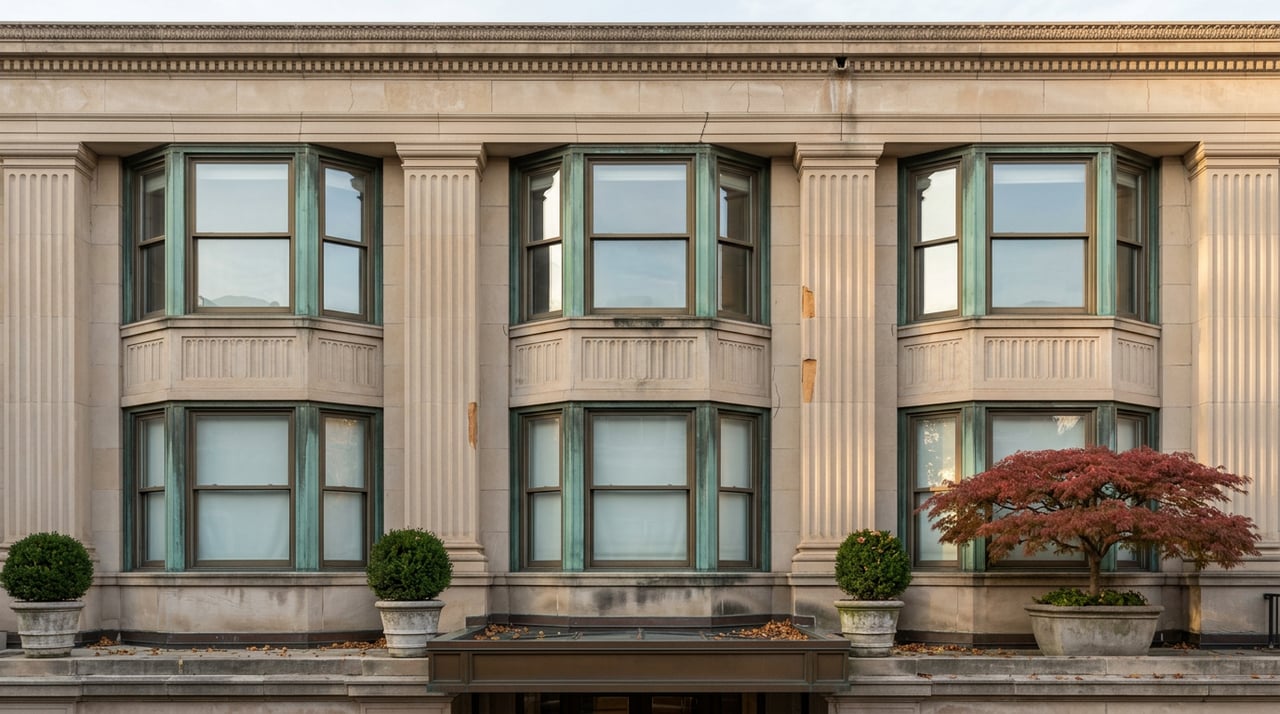
Walk from California Street down to Sacramento on a Saturday afternoon and you can tour two Nob Hill condo towers within twenty minutes of each other. Doorman lobbies. Similar price per square foot. Views that trade Huntington Park for a slice of the Bay depending on which floor you land on. The key difference is whether a building may face a sprinkler retrofit, with costs that can reach six figures per unit.
The line between them isn't the finishes or the HOA dues you see on page one of the disclosure package. It starts with a building's construction date, but its height and stairwell configuration also matter.
The Ordinance Behind the Line
San Francisco's fire code now requires automatic sprinklers in every room of every unit in residential high-rises built before 1975 that stand 12 stories or taller, or that lack two interior stairwells rated to resist fire for two hours. The rule is written into Section 1103.5.4 of the San Francisco Fire Code, and it covers roughly 126 buildings and 9,800 units citywide. Reporting from the San Francisco Chronicle has traced the heaviest concentration of those buildings to Nob Hill, Russian Hill, the Marina, and Telegraph Hill, which happen to be some of the same hillside neighborhoods where prewar and midcentury towers built their reputations on views and doorman service rather than modern fire suppression.
That's the part a per-square-foot comparison will never surface. Two buildings a block apart, one finished in 1963 and one finished in 1978, sit on opposite sides of a compliance requirement that has nothing to do with unit size, renovation quality, or how recent the lobby refresh was.
The Number Nobody Can Quite Agree On
HOA-hired consultants have told the Chronicle that retrofits could run $200,000 to $300,000 per unit. Other industry estimates cited by policy tracker GrowSF put the range as wide as $60,000 to $300,000 per unit, or roughly $600 million to $3 billion across the affected buildings citywide.
That spread isn't noise. It's information. Buildings with existing water infrastructure that can support full sprinkler pressure sit at the low end. Buildings that need an entirely new fire-water system, on top of a pump, storage tank, and backup generator, sit at the high end, and reporting has specifically flagged hilly neighborhoods like Nob Hill and Russian Hill as places where tying into city water mains can require street excavation. In practice, the same terrain that gives these buildings their views is part of what makes the fix expensive.
The Extension Isn't the Exit
In February 2026, a Board of Supervisors committee approved a five-year pause on the interim compliance deadline, the San Francisco Chronicle reported. The full board followed with legislation, co-sponsored by Supervisors Danny Sauter and Stephen Sherrill and backed by Mayor Daniel Lurie, pushing the permit deadline from 2027 to 2032, as The Real Deal reported. It reads like relief, and for owners staring down a near-term assessment, it is. But the final installation deadline for actual sprinkler systems has not moved. It still sits at 2035, according to FireMex Solutions.
For a buyer closing on a Nob Hill unit this year, that timeline matters more than the headline. A standard hold period puts most owners squarely inside the window when the work has to happen, delay or no delay. The Board's vote bought time to plan. It did not remove the bill.
As of this month, the city is still working through what happens next. A newly formed Fire Code Technical Advisory Council held its first hearing on September 18, 2026, and more than 100 condo owners packed the chambers along with an overflow room. One council member who does fire sprinkler design work told the hearing that his review of two buildings on the list produced two completely different answers: one had usable water infrastructure already in place, the other had none. Every building, in other words, is still its own case.
Gina Ferrante, a retired school administrator who owns in the Fontana West building on Russian Hill, put the stakes plainly during testimony covered by NBC Bay Area:
"If this moves forward, what this means to me is that my life will be turned upside down."
Her HOA's leadership has estimated the retrofit at up to $300,000 per unit, driven largely by the cost of routing new piping through asbestos-laden concrete walls.
What to Ask Before You Compare Two Buildings on Paper
A buyer comparing towers by dues and price per square foot is comparing the wrong numbers. The signal that actually separates risk lives in documents most buyers never request.
| Signal to request | Where to find it | What it tells you |
|---|---|---|
| Any mention of the sprinkler ordinance or fire code compliance | Board meeting minutes, last 12 months | Whether the HOA has already engaged an engineer or is still waiting |
| Reserve study line items for fire/life safety systems | Reserve study or funding plan | Whether the board is budgeting proactively or reactively |
| Building height and stairwell configuration | Building disclosures, permit history | Whether the building is even in scope for the 126-building list |
| History of prior capital projects completed without a special assessment shock | Board minutes, engineering reports | Whether this board has a track record of managing large projects well |
None of this shows up in a standard comparative market analysis. It shows up when someone reads the paperwork.
A Building That Already Showed Its Hand
The Nob Hill Condominiums at 1170 Sacramento Street offer a useful contrast, not because the building has resolved the sprinkler question, but because its board already proved it can handle major structural work without blindsiding residents. Built in 1963 and standing 19 stories over Huntington Park, the building carries monthly HOA dues in the $3,192 to $4,201 range. Years ago, its association commissioned a voluntary seismic retrofit, engineered by Thornton Tomasetti with construction by Herrero Builders and detailing work by FD Thomas, using fiber-reinforced polymer to reinforce the building's structural cores. The project was self-funded, and every resident stayed in their unit through construction.
That track record is a different code requirement than the sprinkler mandate, and it doesn't answer whether 1170 Sacramento sits on the list of 126 affected buildings. What it does show is a board culture willing to plan and fund large capital work ahead of a crisis rather than after one. That's the same discipline a buyer should be screening for on the sprinkler question, regardless of which building they're touring.
What This Means If You're Looking at Nob Hill Right Now
If you're comparing Nob Hill towers this fall, the smart move is to stop treating HOA dues as a settled number and start treating them as a starting point. Ask directly whether the building is on the city's list of 126, ask to see any engineering assessment already commissioned, and read board minutes back at least a year for any reference to the ordinance. An investor weighing a multi-unit purchase in a prewar tower should factor a possible per-unit assessment into underwriting the same way they'd factor in a roof replacement or elevator overhaul, because that's functionally what this is.
None of this is a reason to avoid Nob Hill. It's a reason to read the building's paperwork with the same care you'd give the unit's floor plan.
FAQ
Does the delay to 2032 mean I don't need to worry about this if I'm buying now? Not really. The permit deadline moved, but the final installation deadline is still 2035. A typical hold period means most buyers today will own through the window when the work eventually happens.
How do I find out if a specific building is one of the 126? Ask the HOA management company directly, or ask whether the board has received any communication from the SFFD Bureau of Fire Prevention about the ordinance. Board minutes are often the fastest paper trail.
Is this only a Nob Hill issue? No. Russian Hill, the Marina, and Telegraph Hill carry similar concentrations of pre-1975 high-rises, but Nob Hill's mix of grand midcentury towers makes the split especially visible block by block.
If you're weighing two Nob Hill buildings that look identical on the surface, that's exactly the kind of comparison worth a second set of eyes before you write an offer. Susanne Alexander has spent years reading HOA financials and reserve studies the way other agents read floor plans. Let's Connect before you fall in love with a view and inherit someone else's deferred maintenance.
This article is general information, not legal, tax or financial advice. Consult a qualified professional about your situation.